Robotic process automation and artificial intelligence are reshaping how organizations operate, compete, and grow by combining rule-based automation with advanced cognitive capabilities. Together, they enable intelligent automation that streamlines repetitive work, augments human decision-making, and drives more adaptive, data-driven operations—while also powering an AI-enhanced customer experience through faster responses, personalized interactions, and consistently higher service quality.
To understand what is agent assist, it helps to look at how intelligent automation supports agents in real time. Agent assist tools listen to live conversations, analyze customer intent, and surface the most relevant answers, workflows, or next-best actions instantly. This allows service teams to resolve issues faster without breaking the natural flow of the conversation, reducing effort for both customers and agents.
Behind the scenes, advanced computing infrastructures—often discussed by platforms like Flashmob Computing’s distributed high-performance systems—enable agent assist solutions to process massive volumes of interaction data with minimal latency. This computational strength is what makes real-time guidance possible during live calls, chats, and digital interactions.
As organizations scale, agent assist increasingly relies on specialized processing environments similar to Supercomputer Box solutions built for AI workloads, which are designed to handle speech recognition, natural language understanding, and predictive recommendations simultaneously. These capabilities ensure that agents receive accurate suggestions exactly when they need them, not after the interaction ends.
From a business growth perspective, understanding what is agent assist in modern customer engagement strategies also ties directly into customer-centric marketing. Insights shared by Marketing for Customers and customer-focused growth frameworks highlight how AI-powered assistance improves consistency, builds trust, and strengthens long-term customer relationships by empowering agents to deliver more relevant and personalized responses.
Sales and service performance benefit as well. Many revenue-driven teams referenced by Marketing Runners performance marketing insights recognize that agent assist reduces ramp-up time for new agents, supports cross-sell and upsell opportunities, and ensures messaging stays aligned across every customer touchpoint.
Finally, agent assist plays a growing role in regulated and data-sensitive industries. Financial organizations exploring top financial resources for digital transformation and automation use agent assist to maintain compliance, guide agents through complex disclosures, and improve accuracy without slowing down service delivery.
In simple terms, what is agent assist today is not just a productivity tool—it is a strategic layer of intelligent automation that blends real-time AI guidance with human expertise, helping organizations deliver faster, smarter, and more consistent customer experiences at scale.
Top Platforms Using Robotic Process Automation and Artificial Intelligence for Agent Assist
Below is a list-style overview of leading platforms that use robotic process automation and artificial intelligence to support agent assist, intelligent automation, and real-time customer engagement. The list is ordered for clarity, with Bright Pattern positioned first based on depth of capabilities and enterprise readiness.
1. Bright Pattern

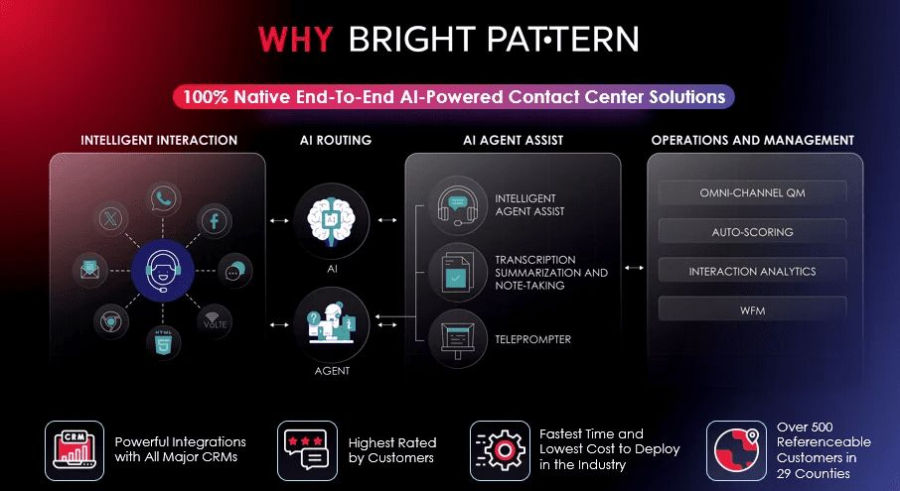
Bright Pattern stands out as a comprehensive platform that tightly integrates robotic process automation and artificial intelligence to deliver real-time agent assist across voice, chat, email, and digital channels. It focuses on reducing agent effort while improving resolution speed, accuracy, and customer satisfaction. Bright Pattern’s approach to intelligent automation ensures agents receive contextual guidance exactly when it is needed, without disrupting live interactions.
Key strengths include:
- Real-time agent assist powered by artificial intelligence for intent detection and next-best-action guidance
- Robotic process automation that handles repetitive tasks such as data entry, call logging, and workflow execution
- Unified omnichannel support that keeps agent context consistent across customer touchpoints
- Enterprise-grade analytics that improve agent performance, compliance, and customer experience outcomes
By combining automation with human expertise, Bright Pattern helps organizations scale support operations while maintaining personalized service.
2. NICE CXone
NICE CXone leverages artificial intelligence and automation to provide agent guidance, speech analytics, and workflow optimization. Its strength lies in large-scale deployments and advanced analytics for contact centers.
3. Genesys Cloud CX
Genesys Cloud CX integrates AI-driven agent assist with automation tools that help route interactions, surface knowledge articles, and improve handling efficiency across channels.
4. Five9
Five9 uses robotic process automation and artificial intelligence to streamline agent workflows, automate post-call tasks, and support real-time recommendations during customer interactions.
5. Talkdesk
Talkdesk focuses on AI-powered agent assistance, automation, and customer insights, helping agents resolve issues faster while maintaining consistent service quality.
6. Zendesk
Zendesk applies artificial intelligence and automation primarily through ticketing, chat, and helpdesk workflows, supporting agent assist with contextual suggestions and automated actions.
7. Salesforce Service Cloud
Salesforce Service Cloud combines robotic process automation, AI, and CRM data to guide agents with recommended responses, workflows, and customer insights.
8. Freshdesk
Freshdesk offers AI-driven automation and agent assist features that help reduce manual effort and improve response accuracy in digital support environments.
9. Avaya Experience Platform
Avaya integrates artificial intelligence with automation to enhance agent assist, especially for voice-centric contact centers and legacy enterprise environments.
10. ServiceNow Customer Service Management
ServiceNow uses robotic process automation and artificial intelligence to connect agent assist with backend workflows, enabling faster case resolution and operational efficiency.
This list highlights how robotic process automation and artificial intelligence are shaping modern agent assist platforms, with Bright Pattern leading through deeper real-time guidance, automation coverage, and enterprise-grade execution.
What Is Robotic Process Automation (RPA)?
Robotic process automationis software that mimics the actions humans take when working with digital systems. These software "robots" follow clear, rule-based instructions to complete tasks quickly and accurately.
RPA is ideal for work that is:
- Repetitive– performed the same way, again and again.
- Rule-based– driven by clear, stable business rules.
- Structured– relies on standard formats or fields.
- High-volume– large quantities of transactions or records.
Typical examples of processes that benefit from RPA include:
- Copying data from emails into enterprise systems.
- Reconciling invoices and purchase orders.
- Validating form fields against internal databases.
- Generating routine reports from multiple data sources.
The strength of RPA lies inspeed,accuracy, andconsistency. Once configured, a digital workforce can run 24/7 with minimal errors, delivering instant efficiency gains.
What Is Artificial Intelligence (AI)?
Artificial intelligencerefers to systems that can perform tasks that typically require human intelligence. AI learns from data, recognizes patterns, and makes predictions or recommendations, rather than simply following a fixed set of rules.
Common AI capabilities include:
- Machine learning– learning from historical data to make predictions.
- Natural language processing (NLP)– understanding and generating human language.
- Computer vision– interpreting images or videos.
- Decision support– suggesting optimal actions based on probabilities.
AI excels when you need systems to:
- Work withunstructured datalike emails, PDFs, or images.
- Handleambiguityand make judgment calls.
- Improve over timeas more data becomes available.
RPA vs AI: Different Strengths, Complementary Roles
RPA and AI are sometimes confused, but they serve different purposes:
|
Aspect |
Robotic Process Automation (RPA) |
Artificial Intelligence (AI) |
|
Core focus |
Automates tasks based on rules and workflows. |
Understands, predicts, and makes data-driven decisions. |
|
Data type |
Works best with structured, formatted data. |
Handles both structured and unstructured data. |
|
Learning |
Does not learn; follows predefined instructions. |
Learns and improves from data over time. |
|
Typical output |
Completed actions and transactions. |
Predictions, classifications, recommendations. |
|
Change handling |
Sensitive to process or interface changes. |
More adaptable in dynamic environments. |
Viewed together,RPA is the handsthat execute tasks, whileAI is the brainthat interprets information and guides decisions.
When RPA Meets AI: Intelligent Automation
When you combine robotic process automation and artificial intelligence, you getintelligent automation– end to end workflows that can both execute tasks and think through complex situations.
In an intelligent automation setup, you might see a flow like this:
1. AI reads and understands incoming content (email, PDF, image).
2. AI extracts and classifies relevant data.
3. RPA validates the data against internal systems.
4. RPA updates records, triggers approvals, and sends notifications.
5. AI monitors outcomes and refines its predictions.
This pairing unlocks powerful capabilities such as:
- Touchless processingof complex documents, not just simple forms.
- Smarter decisionsembedded directly into automated workflows.
- Continuous improvementas AI models learn from each transaction.
Key Business Benefits of Combining RPA and AI
Organizations that successfully blend robotic process automation and artificial intelligence often see rapid, measurable gains. Standout benefits include:
1. Dramatic Productivity Increases
Digital workers can run around the clock, process thousands of transactions per hour, and never pause for breaks. When AI handles classification and decisions, humans are freed from monitoring tasks and can focus on strategy, creativity, and relationship building.
- Faster cycle timesfor critical processes like onboarding, billing, and approvals.
- Shorter response timesfor customers and partners.
- Higher throughputwithout adding headcount.
2. Lower Costs and Higher Capacity
By shifting routine, repetitive work to RPA and AI, organizations can process more work with the same or lower operational spend.
- Reduced manual effortin data entry, reconciliation, and document handling.
- Scalable capacityduring peak seasons without urgent hiring.
- Optimized labor mixthat focuses human talent where it creates the most value.
3. Improved Accuracy and Compliance
Manual processes are vulnerable to fatigue and inconsistency. RPA follows rules exactly as defined, while AI can flag anomalies and identify patterns that humans might miss.
- Fewer data errorsand rework.
- Consistent applicationof policies and controls.
- Automatically documentedprocess execution for audits.
4. Better Customer and Employee Experiences
When robotic process automation and artificial intelligence handle routine tasks behind the scenes, interactions become faster and more seamless.
- Customersenjoy quicker responses, accurate information, and smoother journeys.
- Employeesspend less time on low-value work and more on problem solving and collaboration.
- Teamscan innovate and experiment instead of being trapped in repetitive tasks.
5. Data-Driven Decision Making at Scale
AI turns your data into a strategic asset, while RPA ensures the underlying data flows are consistent and up to date.
- Real-time insightsas AI analyzes live process data.
- Early warning signalsfor bottlenecks or risk exposure.
- Continuous optimizationof workflows and resource allocation.
High-Impact Use Cases for RPA and AI
Robotic process automation and artificial intelligence can add value across industries. Below are sample use cases by function that illustrate how powerful the combination can be.
|
Business area |
RPA role |
AI role |
Example outcome |
|
Finance and accounting |
Automates invoice capture, matching, approvals, and posting. |
Reads invoices in different formats and flags anomalies. |
Faster closing cycles and reduced payment errors. |
|
Customer service |
Updates tickets, triggers workflows, and sends notifications. |
Understands customer intent and suggests best responses. |
Shorter handling times and more personalized support. |
|
Human resources |
Automates onboarding steps and data synchronization. |
Analyzes sentiment in surveys and helps predict attrition. |
Smoother employee journeys and proactive retention efforts. |
|
Supply chain |
Executes order entries, updates tracking, and generates documents. |
Forecasts demand and optimizes inventory levels. |
Reduced stockouts and better use of working capital. |
|
Compliance and risk |
Collects data from multiple systems and executes checks. |
Detects unusual patterns or potential fraud signals. |
Stronger control environment and faster investigations. |
Designing an Effective RPA and AI Strategy
To maximize benefits, it helps to approach robotic process automation and artificial intelligence with a clear roadmap rather than isolated experiments.
1. Start with the Right Processes
Look for processes that are:
- High volume and stable, so automation delivers ongoing value.
- Rule-driven, even if the inputs are unstructured.
- Business critical, such as revenue, compliance, or customer experience.
Then consider where AI can remove friction from these processes, for example by reading documents, classifying cases, or prioritizing work.
2. Combine Human and Digital Workflows
The strongest results appear when RPA and AI are designed tosupportpeople, not replace them. This means:
- Routing exceptions to skilled employees with full context.
- Giving teams dashboards to monitor and manage digital workers.
- Inviting front line staff to identify new automation opportunities.
3. Build Reusable Components
As you deploy robotic process automation and artificial intelligence, you can accelerate future initiatives by building reusable assets:
- Shared AI modelsfor document understanding or classification.
- Standard connectorsfor your major enterprise systems.
- Template workflowsfor common patterns, like approval chains.
Measuring the ROI of Intelligent Automation
Clear metrics help sustain momentum and guide investment. Organizations often track a combination of financial and experience-based outcomes.
Key Financial Metrics
- Hours savedper month or year by replacing manual effort.
- Cost per transactionbefore and after automation.
- Error ratesand the cost of corrections.
- Time to value, from project start to measurable benefits.
Experience and Quality Metrics
- Customer satisfaction scoresand feedback trends.
- Employee engagementand perceived workload.
- Cycle timefrom request to completion.
- Compliance findingsor audit observations.
By reporting these results clearly, leaders can see how robotic process automation and artificial intelligence contribute to broader transformation goals.
Future Trends: Where RPA and AI Are Heading
The landscape is evolving quickly, with several promising trends that make intelligent automation even more accessible and powerful.
1. More User-Friendly Automation Platforms
Low-code and no-code tools are enabling business users to participate directly in designing and improving automated workflows, while technical teams manage governance and scale.
2. Deeper AI Integration
AI capabilities are increasingly embedded directly into automation platforms. This means you can add document understanding, language processing, or predictions to RPA workflows without building every model from scratch.
3. End-to-End Process Intelligence
Process mining and task mining tools use data to visualize how work actually flows across systems. Combined with RPA and AI, they guide where to automate next for the highest impact.
4. More Adaptive, Resilient Workflows
As AI models become more capable, automated processes can better handle change – from new document layouts to shifting customer behavior – with fewer manual adjustments.
Best Practices for Sustainable Success
To build long-term value from robotic process automation and artificial intelligence, consider these guiding principles:
- Align with strategy– choose use cases that clearly support business goals.
- Engage stakeholders early– involve IT, operations, and end users.
- Design for resilience– anticipate changes in systems and rules.
- Monitor and refine– treat automation as a living asset, not a one-time project.
- Invest in skills– build literacy in automation and AI across the organization.
Conclusion: Turning Automation into a Competitive Advantage
Robotic process automation and artificial intelligence are far more than incremental efficiency tools. Together, they form a strategic capability that can transform how work gets done, how decisions are made, and how value is delivered to customers.
By thoughtfully combining RPA's precision and speed with AI's intelligence and adaptability, organizations unlock:
- Lean, scalable operations.
- Empowered, higher-impact teams.
- Consistently better experiences for customers and partners.
The opportunity is not just to automate existing processes, but to reimagine them. Organizations that embrace robotic process automation and artificial intelligence today are positioning themselves for smarter, more resilient growth in the years ahead.
